


In the hotel industry, nothing is neutral.
Nothing.
Everything we place in front of the guest communicates, conditions their behaviour and, if we lose focus for a moment, can work against us.
And tableware… oh, tableware.
That small detail many hotels choose from a catalogue because it looks nice, or worse, because of the price.
When in reality, it is one of the most powerful tools we have to guide the guest: their experience, the amount of food they consume and, therefore, the operational costs of the service. Once you understand this, you stop buying plates and start making decisions.
Tableware speaks before the food does.
And this is a fact.
Before the guest tastes anything, they are already interpreting the service, the perceived quality and the hotel itself. A good plate helps shape that perception in a positive way.
Weight, material, colour and size. everything contributes to creating a silent message that speaks of care, order, professionalism, abundance or scarcity.
And here comes the part many people forget: tableware must be consistent with the hotel’s positioning.
Tableware is also narrative.
A heavy plate communicates quality.
A clean, simple design speaks about the buffet concept.
A small plate, in certain contexts, suggests attention to detail.
A large one can convey abundance — or create an uncomfortable sense of emptiness if not managed correctly.
The size of the plate changes guest behaviour. This is not an idea; it is proven. The Delboeuf illusion, described by Belgian psychologist and philosopher Joseph Delboeuf, is simple: on a large plate, a portion looks smaller; on a small plate, the same portion looks sufficient.
In a buffet environment, this is not theory. It is money.
Large plates lead to more food, more waste and higher costs. Smaller plates encourage balanced portions, reduce waste and increase the perception of care.
And if there is still any doubt, there is the well-known “Bottomless Bowls” study by Brian Wansink. An American researcher specialising in consumer behaviour and food psychology, Wansink studied how the environment influences what we eat and how much we eat.
His research clearly showed that plate size changes how we perceive portions and, consequently, how much we consume. People ate up to 73% more without realising it.
In a hotel, where experience and management go hand in hand, these data are not curiosities. they are tools.
I know… you don’t want small plates at your buffet. Neither do I.
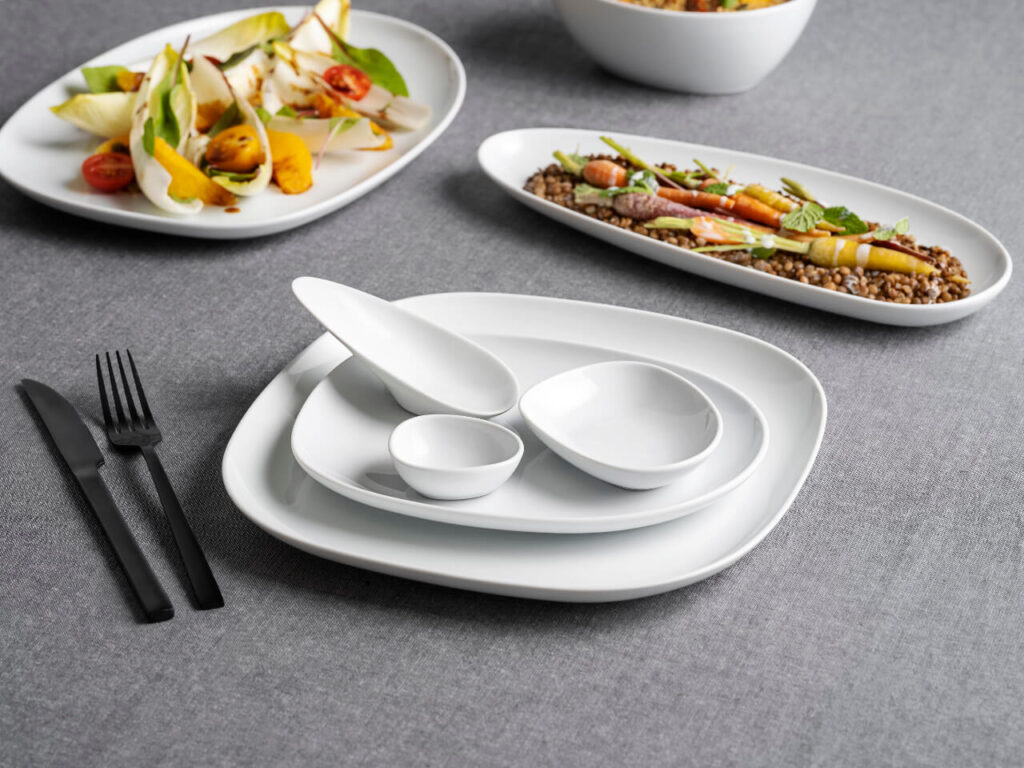
But a plate is more than just a plate. It has two parts: the base and the rim. the surface where the food is placed and the space that frames it. And this is where there is room to manoeuvre. A plate can look large, with a wide rim, yet hold less food than a smaller plate.
Or rather, the perception of quality. What the guest feels without being told.
Tableware influences not only how much a guest eats, but also how they interpret the quality of the service.
Weight and material matter: a heavy plate conveys prestige; a light or chipped plate communicates neglect, even from the other side of the dining room.
Colour and contrast are equally important. White or bone tones enhance food; dark colours add sophistication. Contrast helps guests read portions and presentation more clearly.
And above all, coherence with the brand. Because tableware is not decoration. It is identity. And when it does not align with the concept, it weakens it.
So, what is the operational impact?
The impact appears when aesthetics and management work together. Choosing the right porcelain is not only an aesthetic decision. It is an operational one.
It helps control costs.
It reduces waste.
It improves the perception of service.
Tableware is not an accessory; it is a management tool. And a powerful one.
A plate can elevate, or ruin, the entire experience.
It affects perception, eating behaviour, sustainability and profitability.
The size of the plate changes how we eat and how we interpret what we eat.
In a hotel, where every detail matters, tableware is an opportunity to elevate the experience, reinforce the brand and optimise operations.
So stop seeing it as an expense. Because it isn’t.
It is an investment in consistency, quality and profitability.
And from now on, I hope you will look at your plates with a little more love.

Noemí del Barrio – Consultant / Trainer Chef in Hotel Buffets | Specialist in Customer Experience and F&B Profitability through Gastronomic Branding and Visual Marketing | Top 150+ Tourism Influencers in Spain 2026